Premium Android Tablets 2026: Galaxy Tab S10 Ultra vs OnePlus Pad 2 vs Xiaomi Pad 6S Pro
A real-world comparison of the three most interesting high-end Android tablets of 2026, with prices, specs and a verdict against the iPad Pro M4 for each usage profile.
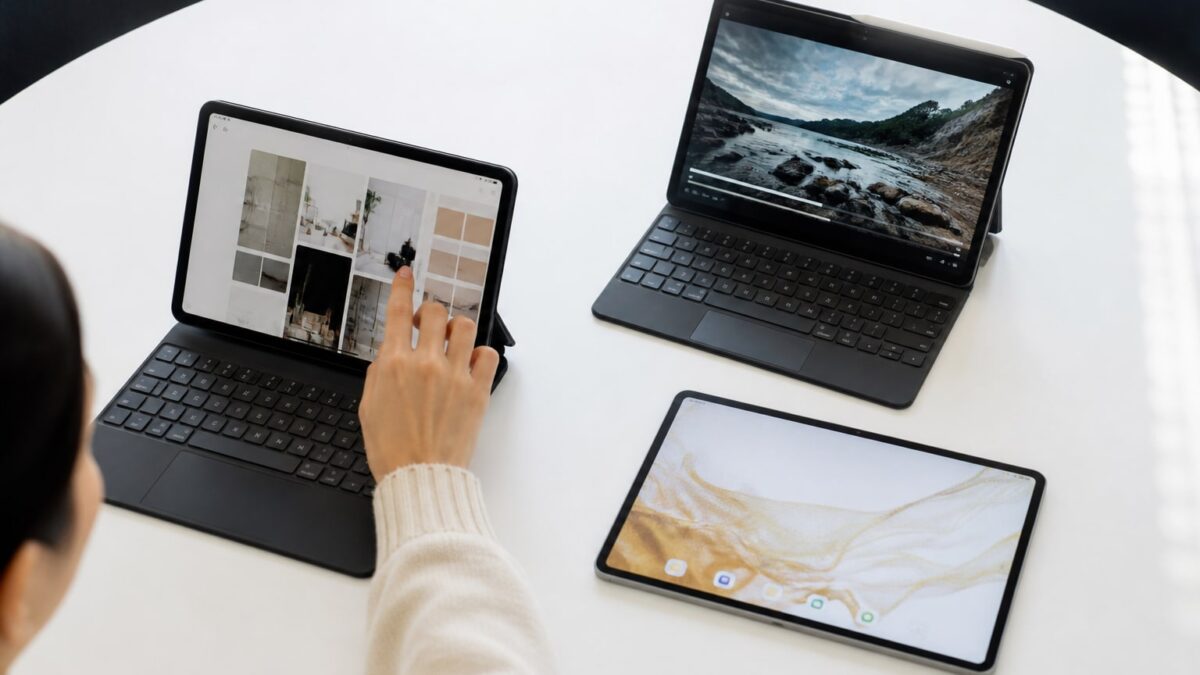
If you use a Mac and an iPhone but are considering an Android tablet, the 2026 landscape has narrowed to three serious contenders: the Samsung Galaxy Tab S10 Ultra, the OnePlus Pad 2 and the Xiaomi Pad 6S Pro. All three compete in the premium space and all three are measured, whether they like it or not, against the iPad Pro M4. This article covers exactly that: which one is worth it, for what profile, and where each one falls short compared to what you already have in the Apple ecosystem.
There is no universal winner. There are three different approaches to what an expensive Android tablet should be, and the choice depends more on your workflow than on the benchmark of the moment.
Quick summary: comparison table
Before going into detail, the essential data for each model (RRP checked in November 2026, base configuration):
| Spec | Galaxy Tab S10 Ultra | OnePlus Pad 2 | Xiaomi Pad 6S Pro |
|---|---|---|---|
| Display | 14.6" AMOLED 120 Hz | 12.1" LCD 144 Hz | 12.4" LCD 144 Hz |
| Chip | MediaTek Dimensity 9300+ | Snapdragon 8 Gen 3 | Snapdragon 8 Gen 2 |
| RAM / Base storage | 12 GB / 256 GB | 12 GB / 256 GB | 8 GB / 256 GB |
| Battery | 11,200 mAh | 9,510 mAh | 10,000 mAh |
| Pen included | Yes (S Pen) | No (Stylo 2 sold separately) | No (Focus Pen sold separately) |
| Base RRP Spain | 1,339 € | 599 € | 699 € |
| iPad Pro M4 11" base | — | — | 1,219 € |
The price jump between Samsung and the other two is massive. And that is precisely what shapes the rest of the analysis.
Samsung Galaxy Tab S10 Ultra: the only one that stands up to the iPad Pro
It is the most complete Android tablet you can buy today. A 14.6-inch AMOLED display, an S Pen in the box, IP68 resistance, four speakers tuned by AKG and DeX as a desktop mode. It is conceptually the closest thing to an iPad Pro, although with less software refinement.
The Dimensity 9300+ performs well in daily use, but it does not play in the same league as the M4 in the iPad Pro. In Geekbench 6 single-core it sits around 40% lower. For browsing, watching video, taking notes or editing documents you will not notice it. For exporting video in LumaFusion, you will.
The S Pen is the jewel. Low latency, tilt detection, inductive charging on the back. If you come from the Apple Pencil Pro, the writing experience is comparable; professional drawing is still better on iPad thanks to the app catalogue (Procreate has no real equivalent on Android).
Weak point: One UI on tablets improves year after year, but Android apps still scale worse than iPadOS apps on large screens. Instagram, WhatsApp or many banking apps still look like stretched phone apps.
OnePlus Pad 2: the most aggressive value for money
At 599 € it is the most rational proposal of the trio. Snapdragon 8 Gen 3, 12 GB of RAM, an aluminium unibody chassis and a 12.1" display with a 7:5 ratio (squarer, better for reading and productivity than the classic 16:10).
The panel is LCD, not AMOLED. You notice it in blacks and HDR, but for work it is perfectly valid and, in fact, it tires the eyes less during long sessions. The 144 Hz refresh rate is more marketing than useful reality: little content takes advantage of it.
OxygenOS for tablets is surprisingly clean. Multi-window mode works well and pairing with OnePlus/Oppo phones is immediate. If your phone is an iPhone, you obviously lose that integration.
What it is good for: a second work screen, media consumption, notes with the Stylo 2 (sold separately, around 99 €). What it is not good for: serious video editing or professional drawing.
Xiaomi Pad 6S Pro: the bet on the HyperOS ecosystem
699 € for a tablet with a 12.4" 3K display, 120W charging and four speakers. On paper it is unbeatable. In practice, the Snapdragon 8 Gen 2 starts to feel old in 2026, especially if you come from an iPhone 15 Pro or newer.
HyperOS 2 has improved on the jump from MIUI, but it still has preinstalled bloatware that has to be cleaned up by hand during the first week. The Focus Pen (99 €) is decent, with 5 ms latency according to Xiaomi, although it lacks inductive charging on the edge like the S Pen.
The best part: integration with other Xiaomi products. If you already have a Xiaomi phone, Xiaomi laptop or Xiaomi smart-home devices, the tablet fits in as an extra piece without friction. If not, much of its appeal disappears.
Chip and performance: what happens beyond the benchmark
In real tasks (office work, browsing with 20 tabs, video calls with simultaneous notes) all three hold up without breaking a sweat. The differences appear in:
- 4K video editing: Tab S10 Ultra and OnePlus Pad 2 are neck and neck, Xiaomi falls behind. None come close to the iPad Pro M4.
- Demanding gaming: Snapdragon 8 Gen 3 (OnePlus) is the most consistent. Samsung’s Dimensity throttles sooner.
- On-device AI: Samsung relies on Galaxy AI with hybrid processing (partly in the cloud). OnePlus and Xiaomi lean more towards the cloud. Apple Intelligence on the iPad Pro M4 is more consistent on privacy but offers fewer creative features.
Display and pen: where the money shows
The 14.6" AMOLED of the Tab S10 Ultra is in another league. 2960 x 1848, adaptive 120 Hz, peak brightness of 930 nits in HDR. For watching series or editing photos it is the best display on an Android tablet, full stop.
OnePlus and Xiaomi use very good LCDs (600–900 nits), but without infinite contrast. For productive work it makes no difference; for premium media consumption, it shows.
In terms of pens, the included S Pen adds real value to Samsung’s 1,339 €. The other two require buying an accessory separately, which narrows the price gap.
Software and updates: where Apple wins
Samsung promises 7 years of Android and security updates. OnePlus, 4 + 6. Xiaomi, 4 + 5. Apple typically gives 6–7 years of full iPadOS support.
If long-term support weighs on your decision, Samsung is the only one that matches Apple. The other two fall short.
To manage file syncing between an Android tablet and a Mac, the cleanest option is to rely on the cloud. If you are unsure, this comparison of cloud storage services may help you choose the one that works best with both systems.
Real price and comparison with the iPad Pro M4
The base iPad Pro M4 11" costs 1,219 € at the Apple Store Spain. Add the Magic Keyboard (349 €) and the Apple Pencil Pro (149 €) and you reach 1,717 €.
The Tab S10 Ultra with the Book Cover Keyboard (349 €) comes to roughly 1,688 €. Practically a tie. Here the decision is purely about ecosystem: if your phone is an iPhone, the iPad Pro wins on integration (Handoff, Universal Clipboard, AirDrop); if it is Android, the Samsung holds its own.
OnePlus Pad 2 and Xiaomi Pad 6S Pro play in a different price league. For 600–700 € they offer 80% of the premium experience. The equivalent iPad in that range is the iPad Air M3 (799 €), which still has a better chip and better support, but a smaller screen.
Verdict by profile
If you want a large tablet for creative work and are not tied to the iPad: Galaxy Tab S10 Ultra. It is the only Android that justifies spending more than 1,000 €.
If you are looking for the best value for money: OnePlus Pad 2. For 599 € there is nothing better in premium Android.
If you are already inside the Xiaomi ecosystem: Pad 6S Pro. Outside that context, the other two beat it.
If your phone is an iPhone: think twice. The iPad Air M3 or the iPad Pro M4 will give you a smoother experience with your current devices. The same applies if you are torn between watch ecosystems, as we saw in the Apple Watch vs Samsung Galaxy Watch comparison: the phone matters more than the specs.
None of the three Android tablets displaces the iPad Pro M4 in raw power or in the quality of optimised apps. But they offer real options for those who do not want to (or cannot) pay Apple’s price, and it is worth knowing them before assuming there is only one answer.
As an Amazon Associate, I earn from qualifying purchases.