Foldable drones: DJI Mini 4 Pro vs Autel Nano+ vs Potensic Atom 2
An honest comparison of the three most relevant sub-250g foldable drones in 2026: specs, image quality, flight time and price to help you decide which one is worth it for your use.
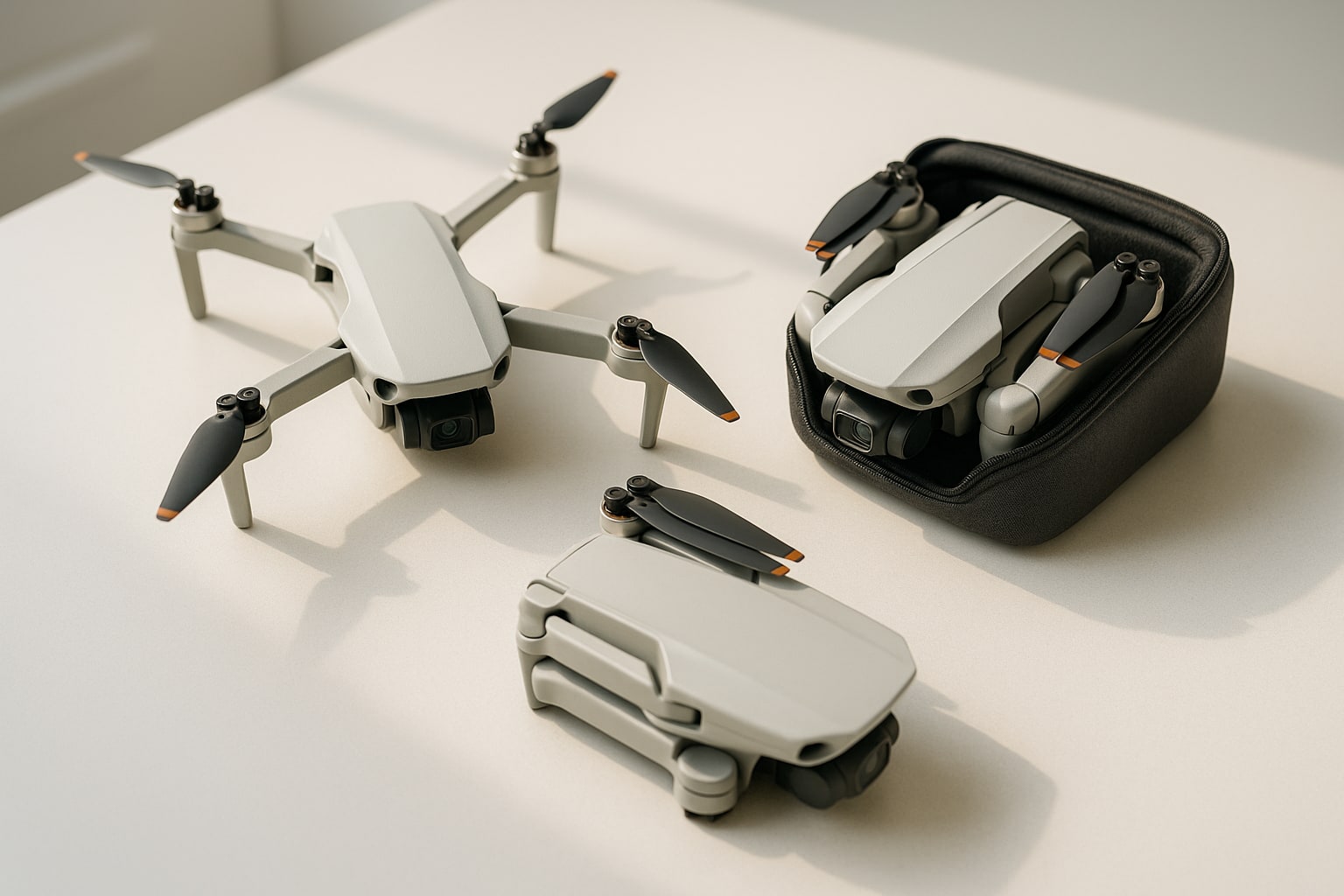
If you’re looking for a drone to travel with without paperwork or complicated licenses, the key is not exceeding 250 grams. That’s the magic threshold that exempts you from registering the aircraft in many European countries and lets you fly in the open category A1 in the EU (with nuances, which we’ll see later).
In 2026 the sub-250g market is more mature than ever. Basically it comes down to three serious contenders: DJI Mini 4 Pro, Autel Nano+ and the newcomer Potensic Atom 2. Let’s see which one is worth it depending on what you want to do with it.
Why the 250-gram limit matters (a lot)
In Spain, under current EASA regulations, a drone under 250 g with class C0 can be flown in A1 without a mandatory course, over uninvolved people (not crowds) and in urban areas with basic restrictions. Go over 250 g and you need to register as an operator, take online training and face harsher limitations.
In practical terms: a sub-250g drone spares you bureaucracy when travelling, lets you take off in more places and, if something goes wrong, your legal liability is lower. It’s not a marketing gimmick; it’s what makes these drones make sense.
Quick comparison table
| Specification | DJI Mini 4 Pro | Autel Nano+ | Potensic Atom 2 |
|---|---|---|---|
| Weight | 249 g | 249 g | 249 g |
| Sensor | 1/1.3" CMOS | 1/1.28" CMOS | 1/2" CMOS |
| Maximum video | 4K/100fps HDR | 4K/30fps HDR | 4K/30fps |
| Photos | 48 MP | 50 MP | 12 MP |
| Flight time | 34 min | 28 min | 32 min |
| Range (OcuSync/similar) | 20 km (O4) | 10 km (OcuSync) | 6 km (PixSync 2.0) |
| Obstacle detection | Omnidirectional | No | No |
| Native vertical video | Yes | No | No |
| Launch price | 799 € (drone only) | 749 € | 349 € |
Prices checked in September 2026 at the official store and retailers in Spain.
DJI Mini 4 Pro: the king (with a king’s price)
It remains the foldable drone to beat. The DJI Mini 4 Pro features a 1/1.3" sensor with an f/1.7 aperture that performs very well in medium light and decently at sunset. It records 4K at 100fps in true HDR, something neither Autel nor Potensic offers.
What sets it apart from the rest isn’t just the camera. It’s the OcuSync 4 system (O4), which stabilises the signal up to 20 km in theory and, in practice, handles urban interference much better than the competition. And above all: omnidirectional obstacle detection. It’s the only sub-250g with sensors in every direction. For beginners it’s a huge safety net.
Automatic modes like ActiveTrack 360°, MasterShots and Waypoints actually work, not as a marketing trick. And native vertical video (the drone rotates the camera 90°) saves you from cropping for Instagram or TikTok.
The catch: the price. The Fly More Plus combo with the RC 2 (controller with built-in screen) costs 1,159 €. The drone with the basic controller alone is 799 €. You won’t find it at Apple Store, but you will at apple.com/es/shop redirecting to partners or directly at store.dji.com.
Autel Nano+: the eternal runner-up with character
The Autel Nano+ has been on the market for a while and in 2026 it’s still relevant, mainly because of its colour. The 1/1.28" sensor with its own processing produces warmer, more saturated tones straight out of the camera, which many people like more than DJI’s flat look.
It records 4K at 30fps with HDR and takes 50 MP photos with good detail. Its weak point: it has no obstacle detection, neither front nor side. If you clip a branch, you’ll be buying new propellers.
The transmission system handles about 10 km of real range in line of sight. Enough for almost any legal use (remember: in Europe you must keep visual contact with the drone, so DJI’s 20 km is more marketing than practical use).
Its differentiating advantage: it doesn’t require prior registration in a Chinese app and doesn’t have GEO zone restrictions as aggressive as DJI’s. For flying in grey areas where DJI blocks your take-off, Autel is more permissive. With the responsibility that entails.
Price: 749 € for the standard combo. It often drops to 599-650 € on Amazon Spain and PcComponentes.
Potensic Atom 2: the surprising value for money
Here’s the interesting news of the year. The Potensic Atom 2 costs 349 € with controller included and does things that were unthinkable three years ago in that price range.
A 1/2" sensor (smaller than the other two), 4K/30fps video with a 100 Mbps bitrate and genuine 3-axis mechanical stabilisation. The PixSync 2.0 transmission reaches 6 km in theory; in the city you get 1-2 km real, which is what you’ll actually fly.
It has no obstacle detection, no real HDR, and no automatic modes comparable to DJI’s. Tracking is basic and the gimbal, although stable, doesn’t reach the smoothness of the Mini 4 Pro.
But for 349 € you get a 249 g foldable drone that shoots decent 4K, lasts 32 minutes per battery and can be taken on a trip without hassle. As a first drone or as a second “spare in case the good one gets lost”, it makes total sense.
Image quality: where the difference shows
In good light, all three record publishable video. The difference shows in:
- Low light: the Mini 4 Pro handles usable ISO 3200-6400. The Nano+ tops out around ISO 1600. The Atom 2, better not to go above ISO 800.
- Dynamic range: the DJI’s true HDR recovers blown-out skies and shadows that the other two lose.
- Codec: DJI records H.265 10-bit D-Log M, which holds up to serious colour grading in DaVinci Resolve or Final Cut. Autel records 10-bit A-Log. Potensic only 8-bit with no flat profile.
If you plan to monetise your video, the difference between DJI/Autel and Potensic is evident from the first clip.
Real flight time and wind
The official figures assume zero wind and ideal temperature. In real use, subtract 20-25%:
- DJI Mini 4 Pro: 25-27 real min, handles wind up to 38 km/h (level 5).
- Autel Nano+: 22-24 real min, handles wind up to 30 km/h.
- Potensic Atom 2: 24-26 real min, handles wind up to 28 km/h.
The Mini 4 Pro is noticeably more stable in coastal breezes or in the mountains. The other two struggle and the shots come out shaky.
Which drone to buy based on your profile
If you travel and want the best possible video: DJI Mini 4 Pro. End of discussion. The extra money is justified by obstacle detection, HDR and vertical video.
If you’re a content creator going for a cinematic look and hate DJI: Autel Nano+. More pleasant factory colour, fewer geographic restrictions, slightly lower price during promotions. You give up obstacle sensors.
If it’s your first drone or you’re after maximum value per euro: Potensic Atom 2. For 349 € you get a functional sub-250g drone. If you crash it, you won’t cry too much. If you get hooked, you’ll sell it to make the jump to the Mini 4 Pro.
When NOT to buy right now: if you’re the type who waits for leaks, there are rumours (unconfirmed, source DroneDJ) of a DJI Mini 5 Pro for Q1 2026 with a 1" sensor. If your purchase isn’t urgent, waiting two or three months makes sense. It’s a rumour, and rumours are rumours, but DJI’s renewal pattern fits.
And one obvious point that gets forgotten: check the regulations of your autonomous community and of ENAIRE before taking off. A sub-250g spares you paperwork; it doesn’t give you a free pass.