HomePod 2 vs Sonos Era 300 vs HomePod mini: which speaker for which use
Honest comparison of HomePod 2, Sonos Era 300 and HomePod mini with prices, drivers, codecs and clear recommendations based on your actual use.
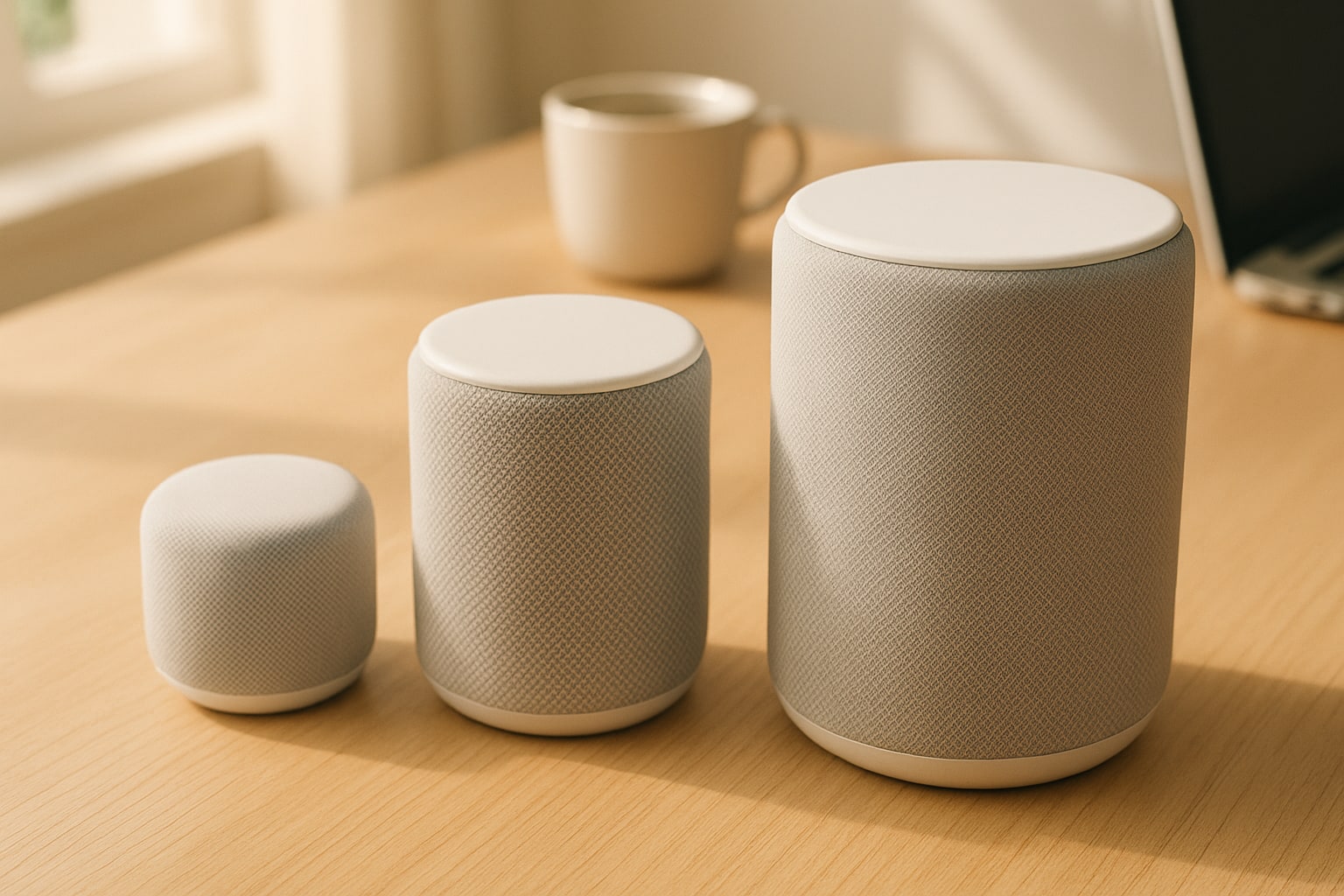
Choosing a smart speaker in 2026 within the Apple ecosystem has become more complicated than it should be. Apple sells two models (HomePod 2 and HomePod mini) with very different philosophies, and Sonos Era 300 remains the obvious option when you want spatial audio without fully committing to Siri. This comparison gets straight to the point: which sounds better, which integrates better with your iPhone and, above all, which one is worth paying for depending on how you listen to music at home.
Quick summary: comparison table
| Feature | HomePod 2 (2023) | Sonos Era 300 | HomePod mini |
|---|---|---|---|
| RRP (Apple/Sonos Spain, Oct. 2026) | 349 € | 499 € | 109 € |
| Drivers | 1 4″ woofer + 5 tweeters | 4 tweeters + 2 woofers | 1 full-range driver |
| Dolby Atmos / Spatial audio | Yes | Yes | No |
| Chip | S7 | Sonos proprietary | S5 |
| Connectivity | Wi-Fi 4, Thread, UWB | Wi-Fi 6, Bluetooth 5.0, USB-C line-in | Wi-Fi 4, Thread, UWB |
| AirPlay 2 | Yes | Yes | Yes |
| Assistant | Siri | Siri (limited) and Alexa | Siri |
| Weight | 2.3 kg | 4.47 kg | 345 g |
Who each one is for
The HomePod 2 is for those who live within the Apple ecosystem and want a speaker that sounds good without fuss. The Sonos Era 300 is for those who genuinely listen to music and care more about quality and flexibility than having Siri at their beck and call. The HomePod mini is the budget all-rounder: cheap multi-room, voice control and HomeKit, with no audiophile pretensions.
Design and build
The HomePod 2 keeps the cylindrical shape with acoustic mesh and an 8.4 cm touch panel on top. It weighs 2.3 kg and takes up little space. Clean, discreet finish that fits on any shelf.
The Sonos Era 300 is another beast: a flattened “hourglass” design, 4.47 kg, much larger. Not ugly, but eye-catching. It has capacitive controls on top, a physical switch to disable the microphones and, note, a USB-C port for auxiliary line-in (you need Sonos’ official adapter, sold separately for €25).
The HomePod mini is an 8.4 cm tall ball, 345 g, available in colours (white, space grey, orange, yellow, blue). It looks best on a bedside table or in the kitchen.
Sound: where the real difference lies
There is no tie here.
The Sonos Era 300 has 6 drivers (four tweeters, two of them firing sideways, one upwards for Atmos, and two woofers). The result is a wide soundstage, punchy bass and plenty of midrange detail. For music, it is clearly the best of the three.
The HomePod 2 holds its own very well for its size thanks to its 5 tweeters in an array and computational processing. It detects the room and adjusts the equalisation. It sounds warm, with generous bass (sometimes too much), and spatial audio works well with tracks mixed in Dolby Atmos. A stereo pair of HomePod 2 matches and in some respects surpasses a single Era 300, but you’re looking at €698.
The HomePod mini does the job. For the kitchen, bathroom, a secondary bedroom or asking Siri to put on the radio. Don’t expect deep bass or real stereo separation. For background music, more than enough.
Spatial audio and Dolby Atmos
HomePod 2 and Sonos Era 300 both play Dolby Atmos. The Sonos can also be paired with a Sonos Arc to act as surround in a cinema setup. The HomePod 2 only does Atmos via Apple Music or as speakers for the Apple TV 4K (in a pair).
The HomePod mini does not play Atmos. It downmixes to stereo.
If your plan is to build a serious home cinema system, Sonos remains more versatile. If you’re going for an Apple TV 4K plus a pair of HomePod 2, that also works very well and is more plug-and-play.
Codecs and music services
The HomePod 2 and the mini are designed around Apple Music. They support Lossless up to 24-bit/48 kHz via AirPlay 2 (not native ALAC; there is compression in transmission). Spotify, YouTube Music or Tidal work via AirPlay from the iPhone, but they are not native: you can’t ask Siri to “play that song on Spotify” without extra steps.
The Sonos Era 300 has its own app with native integration for Spotify, Tidal, Amazon Music, Apple Music, Qobuz, YouTube Music and radio. It plays Tidal in Max quality (up to 24/192). It also supports AirPlay 2, so from an iPhone it works the same as a HomePod for sending audio.
For audiophiles using Tidal or Qobuz, the Sonos wins hands down.
Integration with the Apple ecosystem
This is where Apple has the edge. HomePod 2 and mini are part of Home (HomeKit) and Matter. You can use them as a Thread hub, hand off audio by bringing your iPhone close (UWB chip), use them as a smart doorbell, intercom between rooms, and Siri works with the full context of your devices.
The Sonos Era 300 integrates with HomeKit only as an AirPlay speaker. It is not a Thread hub. Siri only works from the iPhone via AirPlay, not from the speaker itself (Sonos dropped direct Siri support years ago; the speaker now uses its own “Sonos Voice Control” and Alexa, but not local Siri).
If your home is HomeKit-based and you use automations, the HomePods win without question.
Price and recommended setup
Official prices as of 17 October 2026:
- HomePod mini: €109 at the Apple Store Spain. At El Corte Inglés and Amazon it is usually at the same price; sometimes it drops to €99 during specific promotions.
- HomePod 2: €349. Stereo pair, €698.
- Sonos Era 300: €499 at sonos.com and Media Markt. Stereo pair, €998.
Sensible setups by budget:
- Up to €220: two HomePod mini as a stereo pair. Better than a single mini in any room.
- €350: one HomePod 2. For a small living room or office.
- €500: one Sonos Era 300. If music is the priority and you use a variety of services.
- €700: a pair of HomePod 2. If you live in Apple’s world and want cinema + music.
- €1000: a pair of Sonos Era 300. Serious, flexible audio, with optional cinema later via an Arc.
What the adverts don’t tell you
The HomePod 2 still uses Wi-Fi 4 (802.11n) in 2026. That’s ridiculous at its price. It works, but on heavily congested networks you’ll notice.
The Sonos Era 300 requires the Sonos app for initial setup and updates. The app has improved a lot since the 2024 fiasco, but it is still more awkward than opening Home on an iPhone.
The HomePod mini does not play real Lossless audio; there is a bottleneck in transmission. For most people it doesn’t matter, but if you’re buying it thinking of “cheap hi-fi”, it isn’t that.
None of the three has a battery. They are mains-powered speakers.
Verdict by profile
If you’re 100% in Apple and want decent sound with zero friction: HomePod 2. A stereo pair if the budget allows.
If music matters above all and you mainly use Tidal, Qobuz or Spotify: Sonos Era 300. Accept that Siri is relegated to the iPhone.
If you want voice control, HomeKit and cheap multi-room: HomePod mini, one per room. Combine it with a HomePod 2 in the living room if you want to scale up.
If you’re going to complement the speaker with other accessories for your Mac, take a look at our comparison of mechanical keyboards for Mac and, if you use your iPhone daily with several services, our guide to the iOS 18 Passwords app will save you headaches when linking accounts to the speakers.